

The Post-Quantum Wake-Up Call: Why the New NIST Standards Change Everything
In August 2024, the National Institute of Standards and Technology (NIST) released the first finalised post-quantum cryptography standards with FIPS 203, 204, and 205. ML-KEM, ML-DSA, and SLH-DSA are gradually replacing RSA, ECDSA, and other classical schemes that could be broken by sufficiently powerful quantum computers. What may sound like a purely academic issue is in fact an operational challenge for every organisation that develops or operates software today.
The real challenge does not lie in the new algorithms themselves — it lies in the question of how quickly existing systems can be migrated to them. Anyone who has embedded cryptographic methods deep in their architecture will painfully discover: reactive patching is not enough. Crypto agility is not an optional feature for the future. It is a strategic architectural principle that should already be implemented today.
Crypto Agility Demystified: Definition, Scope and Distinctions
Crypto agility describes a system’s ability to swap out cryptographic algorithms, parameters, and protocols without deep architectural interventions. A crypto-agile system can respond to new standards without development teams having to launch months-long refactoring projects.
It is important to distinguish it from related concepts:
- Algorithm Negotiation describes the dynamic agreement between two communication partners on an algorithm (e.g. in TLS). This is one aspect, but not a complete crypto agility strategy.
- Key Management governs the lifecycle of cryptographic keys. It is a necessary prerequisite, but not sufficient on its own.
- Crypto Agility is the overarching concept: an architectural strategy that spans all layers — from the primitive level to governance.
Crypto agility does not mean supporting an arbitrary number of algorithms in parallel. It means creating the right level of abstraction, so that algorithms are configurable, exchangeable, and auditable.
The Hidden Costs of Cryptographic Rigidity: Real-World Failure Patterns
The history of cryptography is also a history of expensive migrations. Anyone who has lived through the retirement of MD5 and SHA-1 knows how painful it is when an algorithm is deeply rooted in legacy code, protocol stacks, and certificate chains.
SHA-1 was already classified as weak back in 2005. Its complete retirement in many systems nevertheless stretched over more than a decade — with significant costs for compliance, interoperability, and security risks in the meantime. The same applies to MD5, DES, and early SSL versions.
The pattern is always the same:
- An algorithm is classified as insecure.
- Organisations discover that it is used in dozens of places within the system — often undocumented.
- Migration projects are launched that turn out to be significantly more expensive and riskier than expected.
- In the meantime, the system remains exposed.
The business case for crypto agility is therefore clear: those who invest in flexibility today avoid crisis projects tomorrow.
Building Crypto-Agile Systems: Architectural Patterns and Engineering Practices
The heart of crypto agility lies in decoupling. Cryptographic decisions must not be baked into business logic, database schemas, or protocol implementations. Instead, the following principles apply:
Abstraction layers for cryptographic primitives Cryptographic operations are encapsulated behind interfaces. Whether AES-GCM, ChaCha20, or a post-quantum scheme sits underneath is irrelevant to the calling code. Frameworks such as Tink (Google) or the JCA/JCE provider mechanism in Java move in this direction.
Algorithm Independence
Algorithms are not hardcoded as constants but treated as configurable parameters. No SHA256withRSA directly in the code — instead, a policy reference that is resolved at runtime or deployment time.
Late Binding of Cryptographic Decisions The later in the process a concrete algorithm is fixed, the more agile the system is. Configuration-driven crypto policies make it possible to switch algorithms centrally without having to change code.
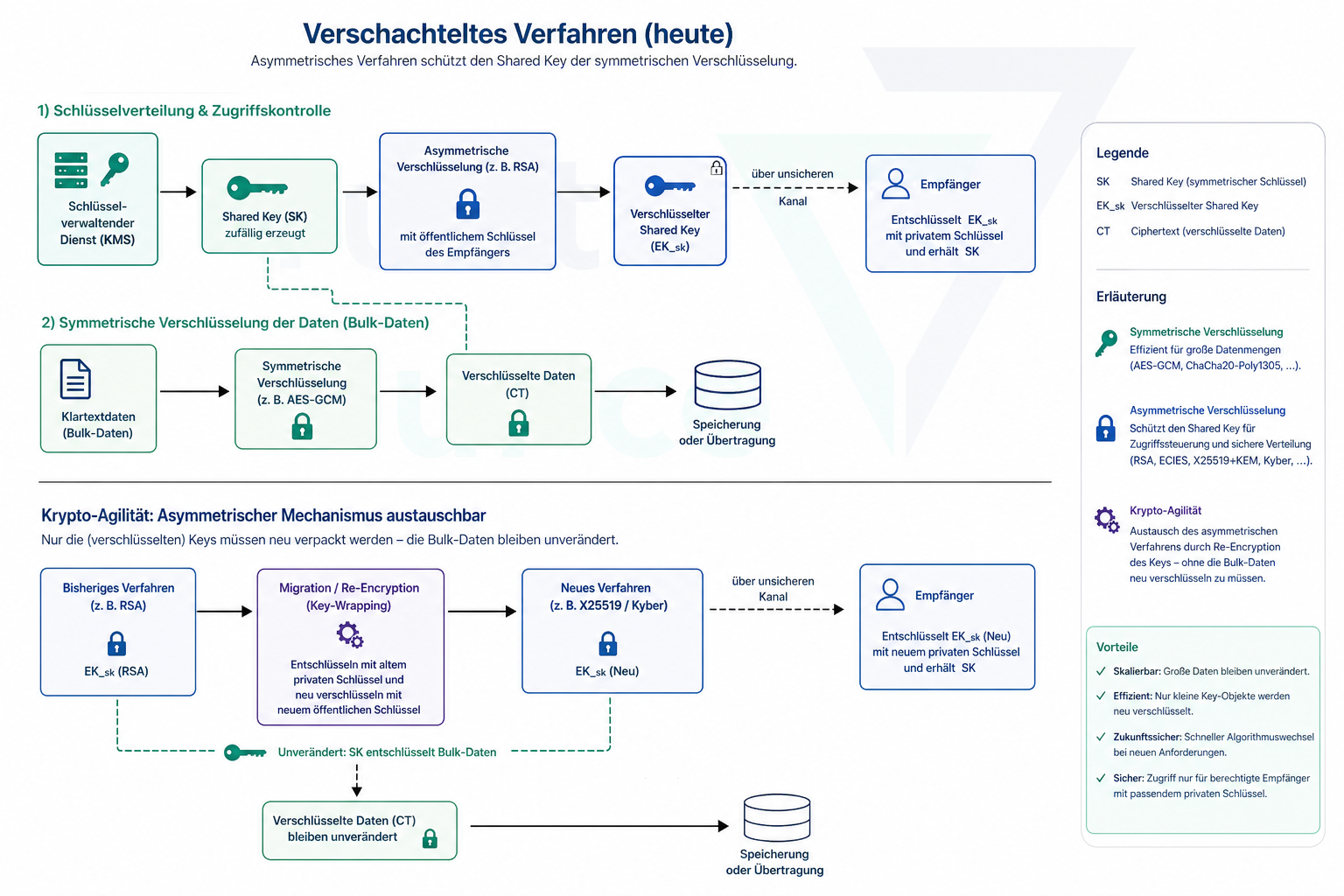
Algorithm Negotiation For protocols the rule is: both sides should support multiple algorithms and be able to agree on the most secure common denominator. Hybrid approaches — classical and post-quantum in parallel — are a proven transitional strategy.
Configurable Key Management Keys should be generatable, storable, and rotatable in an algorithmically flexible way. HSM integrations and key management systems such as HashiCorp Vault or AWS KMS already provide good starting points here.
Crypto Agility Meets Supply Chain: The Role of SBOM and CBOM
Software is rarely written from scratch. Libraries, frameworks, and third-party components bring their own cryptographic dependencies with them — often invisible to your own organisation.
A Software Bill of Materials (SBOM) makes software components visible and auditable. The logical extension is the Cryptographic Bill of Materials (CBOM): a structured inventory of all cryptographic methods, key lengths, protocol versions, and certificates used in a system or its supply chain.
A CBOM answers questions such as:
- Which components still use SHA-1 or RSA-1024?
- Which third-party libraries are not post-quantum-compatible?
- Where are cryptographic keys generated, and with what parameters?
In the context of Supply Chain Risk Management, a CBOM becomes mandatory: those who do not know their cryptographic dependencies can neither protect nor migrate them. Regulatory requirements — from NIS2 to the Cyber Resilience Act — are increasingly moving in this direction.
Operationalising Crypto Agility: From Policy to Pipeline
A concept remains ineffective if it is not translated into operational processes. The following measures make crypto agility practical:
Crypto agility checks in CI/CD pipelines Automated scans detect insecure or outdated cryptographic methods in code — similar to how SAST tools identify security vulnerabilities. Tools such as TrustSource DeepScan also enable the analysis of proprietary, sensitive code within your own data centre — without source code leaving your own infrastructure. This is particularly relevant for regulated industries and security-critical environments.
Cryptographic Policies as Code Crypto policies are defined in machine-readable form — for example as YAML or JSON configurations integrated into the deployment pipeline. This allows permitted algorithms, minimum key lengths, and certificate requirements to be managed and versioned centrally.
TrustSource Algo-Lake The TrustSource Algo-Lake provides a curated, continuously updated knowledge base on cryptographic algorithms — including their security assessments, NIST compliance, and post-quantum readiness. This dataset can be integrated directly into automated compliance checks and policies.
Governance for Cryptographic Asset Management Cryptographic assets — algorithms, keys, certificates, protocol versions — must be managed like any other IT assets: with ownership, lifecycle management, and regular reviews.
The Way Forward: Prioritisation Framework and First Steps
Crypto agility cannot be introduced overnight. A structured approach helps:
Phase 1 – Inventory Create a CBOM: inventory all cryptographic methods, libraries, and keys in your systems and their supply chains.
Phase 2 – Risk Classification Prioritise by exposure and criticality: which systems are most at risk from quantum computer attacks? Which data has long-term confidentiality requirements (harvest-now-decrypt-later)?
Phase 3 – Architecture Review Identify cryptographic hardcoding and missing abstraction layers. Derive concrete refactoring measures.
Phase 4 – Policy and Tooling Implement crypto policies as code and integrate crypto agility checks into your CI/CD pipeline.
Phase 5 – Migration and Monitoring Start the gradual migration to post-quantum-secure methods, beginning with the most critical systems. Establish continuous monitoring of cryptographic assets.
For more on this topic — including practical insights from experts — see the latest episode of the EACG Security Podcast on Crypto Agility: https://www.eacg.de/en/podcast/s06-crypto-agility/
Conclusion
Three key takeaways remain: First, the 2024 NIST post-quantum standards make it clear that migrating to new cryptographic methods is no longer a question for the future — it is a present-day obligation. Second, crypto agility is the decisive architectural principle that makes the difference between a controlled migration and a costly crisis project. Third, crypto agility requires operational implementation: a CBOM for visibility, automated checks in the pipeline, and clear governance — supported by specialised tools such as TrustSource DeepScan and the Algo-Lake.